Caracal offspring
Animal news | 7 January 2026
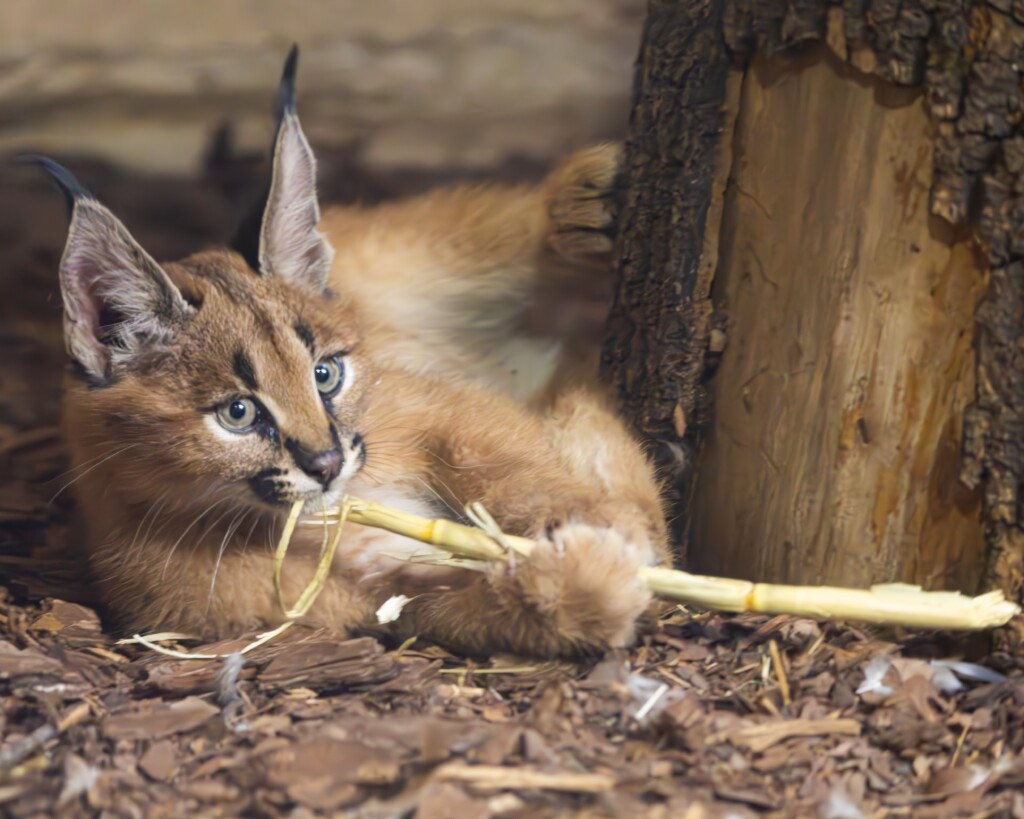
Around seven weeks after his birth behind the scenes, caracal kitten Karlos moved into the exhibition enclosure for the first time yesterday. For parents Donna and Harvey, he is their first offspring together, and for Dresden Zoo, he represents the next chapter in a continuing, decades-long tradition of breeding these elegant wild cats.
To our great delight, a birth took place behind the scenes in the caracal enclosure on 17 November 2025. Two kittens were born, one of which sadly died within the first few hours of life. Fortunately, the second kitten is very fit and has been coming on fantastically for more than seven weeks. The little male has been named Karlos.
Our team of animal keepers guessed that three-year-old Donna had successfully conceived from her continuous weight gain, which became apparent during regular weighing training. The birth itself took place without male cat Harvey, so the young mum could concentrate fully on her offspring. Caracals are solitary animals, and males do not help rear the young.
The young animals are still blind in the first few days of life and therefore dependent on the protection of the birthing den and their mother. Their coat is fully developed at birth, and their ears are still flat in the beginning. From the second week of life, they slowly begin to straighten up until their distinctive tufted ears are formed at around four weeks of age.
Since yesterday, Donna and Karlos have moved from the rear mother-and-child den to the exhibition enclosure, where, with a bit of luck, they can be observed. Meanwhile, Harvey the male is still being kept separate from the two of them until mum and offspring have settled in well and Karlos has grown a bit more.
We are very proud to be successfully raising another caracal at our zoo for the first time in eight years, as this species has a special significance for us: in 1937, the first captive breeding of this species in the world took place at our zoo.